Australian Heroines of World War One by Susanna De Vries
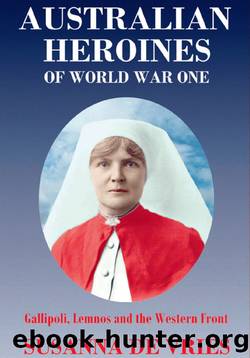
Author:Susanna De Vries [De Vries, Susanna ]
Language: eng
Format: epub
Tags: Biography - Women, Biography - Military
ISBN: 9781742983509
Publisher: Pirgos Press
Published: 2013-08-28T00:00:00+00:00
PART FOUR
âANZAC GIRLSâ IN FRANCE
Sister Florence James-Wallace
(1886-1971)
and
Sister Anne Donnell
(1875â1956)
IN DANGER NEAR THE FRONT LINE
Nothing here but blood, suffering and death. Sister Minnie Procter, Casualty Clearing Station, Grévillers.
When Anne Donnell and Florence James-Wallace enlisted in No. 3 Australian General Hospital (3 AGH) in April 1915, serving under Matron Grace Wilson, they were motivated by patriotism, a wish to nurse fellow Australians and the hope of working overseas. Many nurses imagined serving in war would be romantic. They had no idea of the horrific wounds that German machine guns could inflict.
After surviving five months of hardship on Lemnos Anne and Florence were posted to France, bombed nightly when working at Calais Hospital and selected to work near the battle lines. These brave young women worked in Casualty Clearing Stations situated close to railheads, which had been established in tents, disused barns or bombed-out farmhouses. Instead of beds trestles were used to hold stretcher cases and as emergency operating tables. With large numbers of amputations performed, surrounded by blood and corpses, working at a CCS was sometimes compared to working in a butcherâs shop. The staff were bombed by German planes, often on a nightly basis. Every nurse who worked in a CCS deserved an award for bravery â however, few received this honour. These were not places for the squeamish â nurses and doctors working there needed to be strong physically and mentally and able to cope with the reality that many of their patients would die before they reached a hospital.
Florence James-Wallace had enlisted in the AANS in April, 1915, a month after the Gallipoli landing.1 Her younger brother had already joined the Australian Imperial Force (AIF), which may have prompted her to enrol in the AANS. On her Attestation (Enrolment) Form Florence gave her age as 29 and her family home as Athlone, in the Brisbane bayside area of Wynnum.2
As members of the newly formed Third Australian General Hospital (3 AGH) the nurses believed they were being sent to northern France where trench warfare was causing many casualties. Preparations were made for 3 AGH to work in a British hospital at Etaples, now the largest army camp in France.
Florence and Anne had to provide, at their expense, items of Army uniform as well as a canvas kit bag, a camp bed, a portable canvas bath and a small paraffin stove. AANS nurses had to prepare special meals including nourishing broths for seriously ill patients who could not eat the bully beef provided by the Army and each nurse needed a shipping trunk with her full name and that of her unit painted on it in large white letters.
Florenceâs parents were Anglo-Irish Protestants from Killarney who, in search of a better life had believed the promises of the Queensland Government, who, to enlarge its small population, had advertised in Ireland for migrants. The Queensland Government had run an advertising campaign praising the sunny climate and the availability of cheap farmland.3
These glowing promises attracted Florenceâs father who took up land and ran
Download
This site does not store any files on its server. We only index and link to content provided by other sites. Please contact the content providers to delete copyright contents if any and email us, we'll remove relevant links or contents immediately.
Waking Up in Heaven: A True Story of Brokenness, Heaven, and Life Again by McVea Crystal & Tresniowski Alex(37766)
Still Foolin’ ’Em by Billy Crystal(36333)
Cecilia; Or, Memoirs of an Heiress — Volume 1 by Fanny Burney(32527)
Cecilia; Or, Memoirs of an Heiress — Volume 2 by Fanny Burney(31928)
Cecilia; Or, Memoirs of an Heiress — Volume 3 by Fanny Burney(31916)
Fanny Burney by Claire Harman(26582)
Empire of the Sikhs by Patwant Singh(23057)
We're Going to Need More Wine by Gabrielle Union(19020)
Hans Sturm: A Soldier's Odyssey on the Eastern Front by Gordon Williamson(18553)
Plagued by Fire by Paul Hendrickson(17391)
Out of India by Michael Foss(16837)
All the Missing Girls by Megan Miranda(15889)
Cat's cradle by Kurt Vonnegut(15295)
Pimp by Iceberg Slim(14464)
Molly's Game by Molly Bloom(14119)
Bombshells: Glamour Girls of a Lifetime by Sullivan Steve(14038)
For the Love of Europe by Rick Steves(13817)
Leonardo da Vinci by Walter Isaacson(13291)
4 3 2 1: A Novel by Paul Auster(12354)
